The Sattingers
Public edition, 1769 to 1923. The younger generations remain with the family. Quotations stay in the original German, Latin or Hungarian, with a translation; a ° marks something inferred or taken from the family tree rather than read in a record.
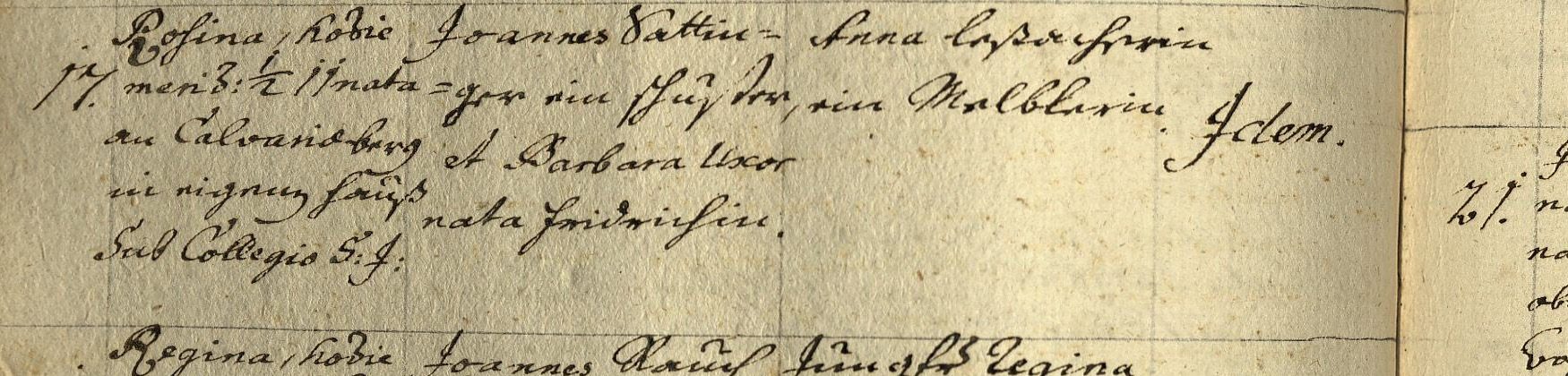
“in a house of their own at the Calvary”
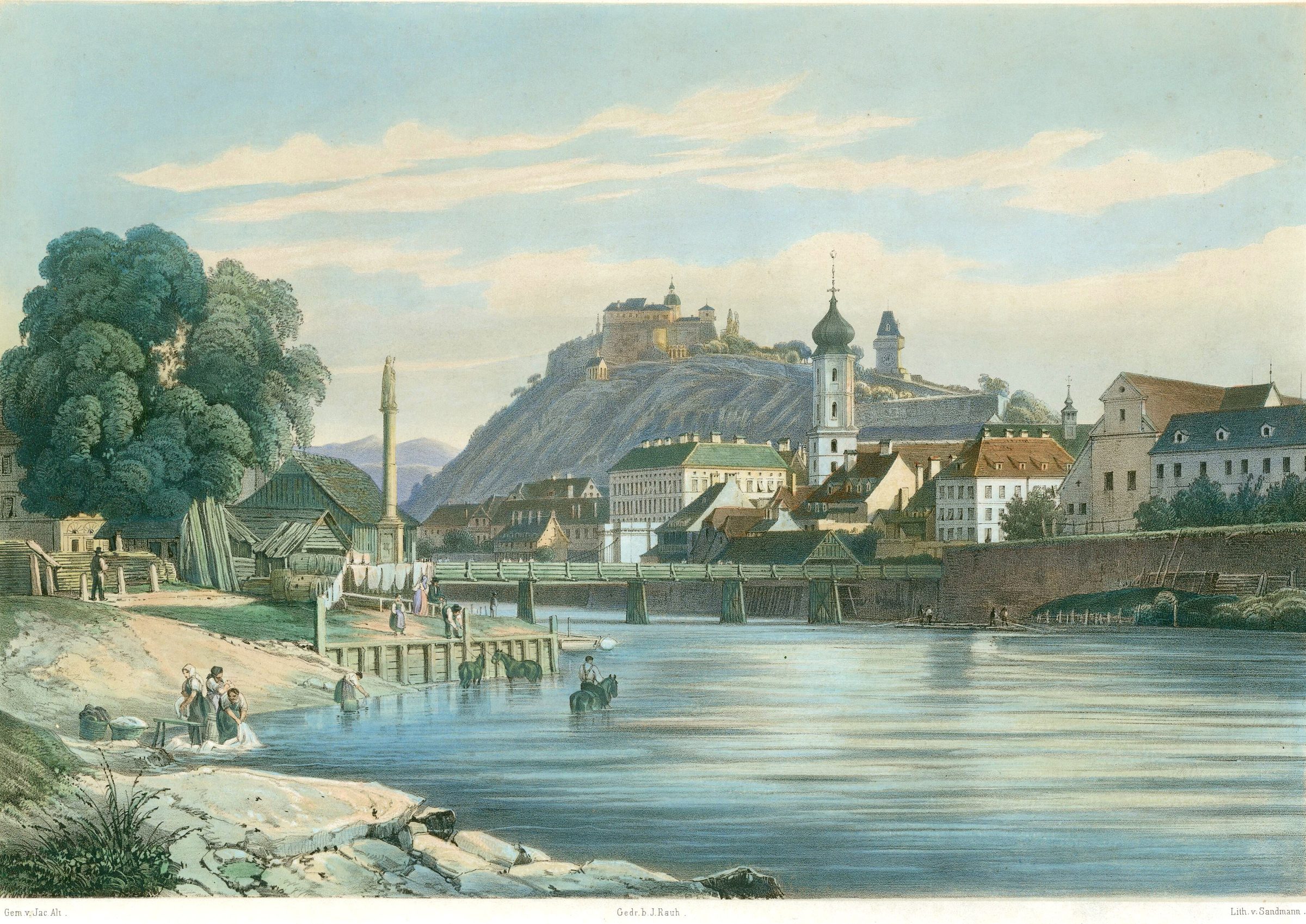
On 17 October 1769 Rosina is baptised, daughter of “Joannes Sattinger ein Schuster, et Barbara Uxor” — Joannes Sattinger, a shoemaker, and his wife Barbara — born “an Calvarieberg in eignen Hauß sub Collegio S.J.”, at the Calvary Hill in a house of their own, on the ground of the Jesuit college. Four more children follow in house 738: Maria Anna in 1772, Simon in 1774, Maria Anna Theresia in 1777, Jacobus in 1779.
From 1774 the landlord is named as the “Hofkammer”, the court treasury: the order had been dissolved in 1773. The father is a shoemaker, in 1777 a journeyman shoemaker, and once, in 1774, a “Musicant”. The mother’s maiden name is written Gridlin three times, and once, in 1769, Fridrichin.
How this Johann and the younger Johannes were related, no entry says. Reinhard’s tree makes Johann the uncle°.


“Joannes Sattinger, Drechßler · Johanna gebor: Kränzerin”

On 17 July 1785, at five in the morning, Magdalena is born in house 1054 “sub Camera”, legitimate, daughter of Joannes Sattinger, a turner, and Johanna née Kränzerin. The godmother is Elisabetha Iberin, a farmer, who signs with a cross.
This is the only baptismal entry of that couple in Graz. Their son Andreas, born by his own account in Graz in 1782 or 1783, appears in no Graz baptismal register of those years. The marriage of Johannes and Johanna is in no Graz parish either.
Where Johanna Kränzer came from, and where the couple married, is not known.
House 2 and house 94
On 25 December 1802 Johannes Sattinger dies in house 2, aged 41, of consumption. The trade column reads “gwesen ein Arbeiter”, had been a labourer. His daughter Magdalena was seventeen, his son Andreas twenty.
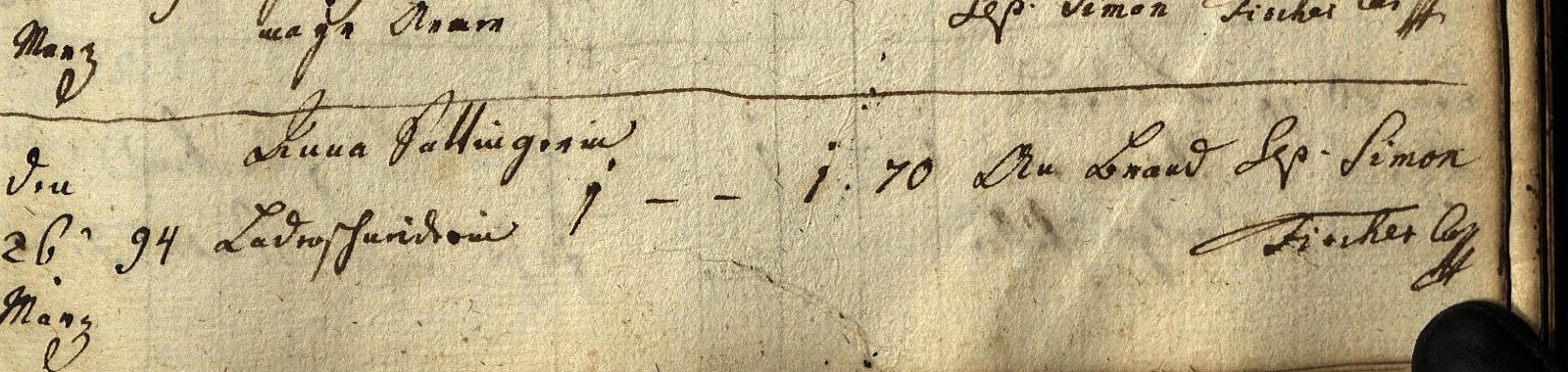
Three months later, on 26 March 1803, Anna Sattingerin, a leather cutter, dies in house 94, aged 70, of gangrene. She was born about 1733.
Whether Anna was the mother of Johannes, no entry says. Reinhard’s tree lists him as her son, with no father°. The ages fit.

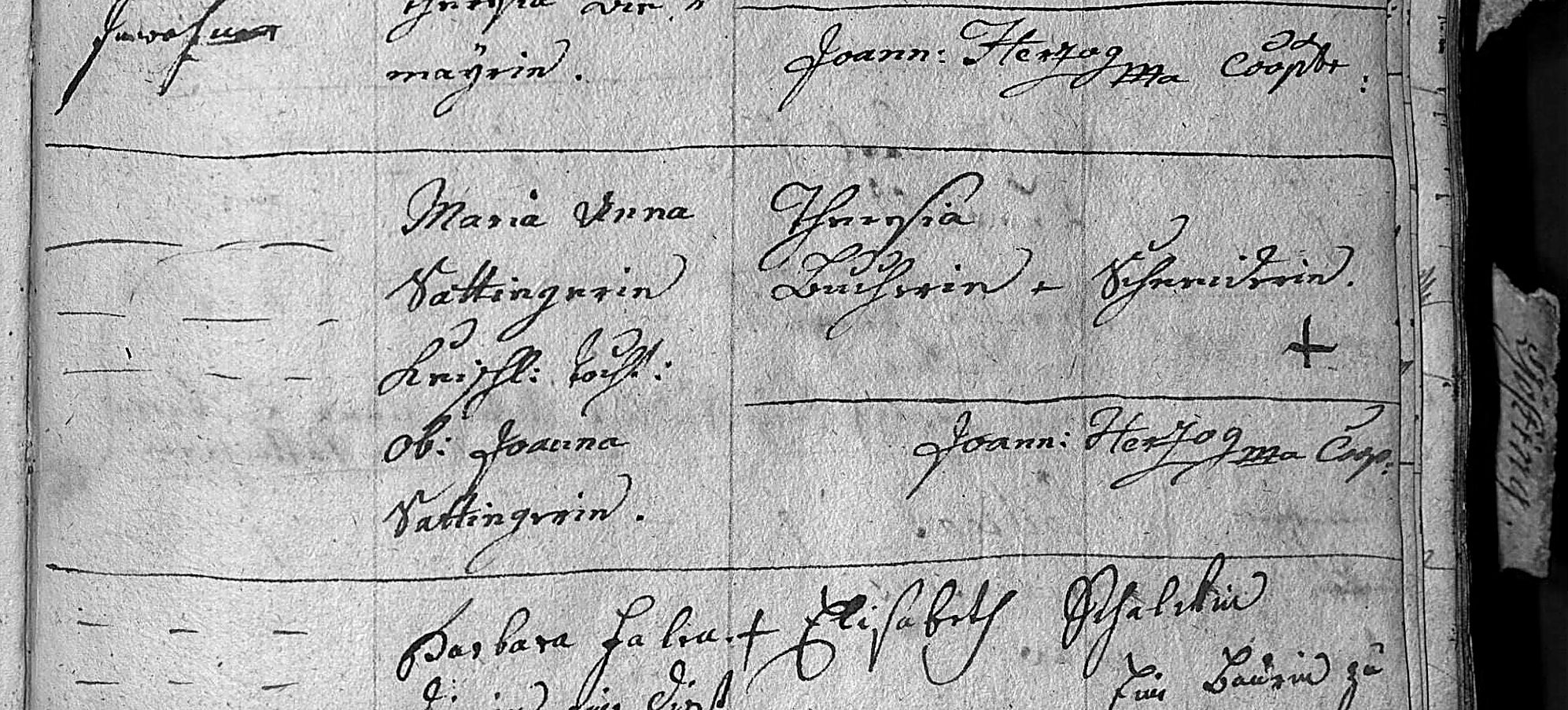
Sotinger, Sattingerin, Satingerin
In 1799 Maria Anna Sattingerin, “led: Greißl: Tocht:” — an unmarried grocer’s daughter — bears a daughter, Maria; the midwife is called Joanna Sattingerin. In 1802 an Anna Sattingerin marries Franz Marchel, with “Johan Sattinger, Kreüßler” as witness: the shoemaker of 1769 is a grocer in his old age.
On 13 March 1808 Johan Sotinger dies in house 58, aged 73, of gangrene. On 7 April 1809 Elisabeth Sattingerin dies in the same house, aged 60. On 26 March 1811 Barbara Satingerin, ein Wittib, a widow, dies in house 96, aged 74, of dropsy.
Four spellings of one name in a single book. Where the three old people had come from, no entry records.


“Sattinger Andrae, owner of the inn and brewhouse”

“Sattinger Andrae, Besitzer des Gast und Bräuhauses in der Schmidgasse N: 355, 38 Jahr alt, ledig, von Graetz gebuertig.” — owner of the inn and brewhouse in the Schmidgasse no. 355, 38 years old, unmarried, born in Graz. On this day Andreas swears the burgher’s oath, alongside an innkeeper of the Golden Lion, a butcher and a toolsmith.
Three facts in one line: born in 1782 or 1783, in Graz, and at 38 still unmarried. The inn and brewhouse in the Schmidgasse is already his.
Master brewer and innkeeper
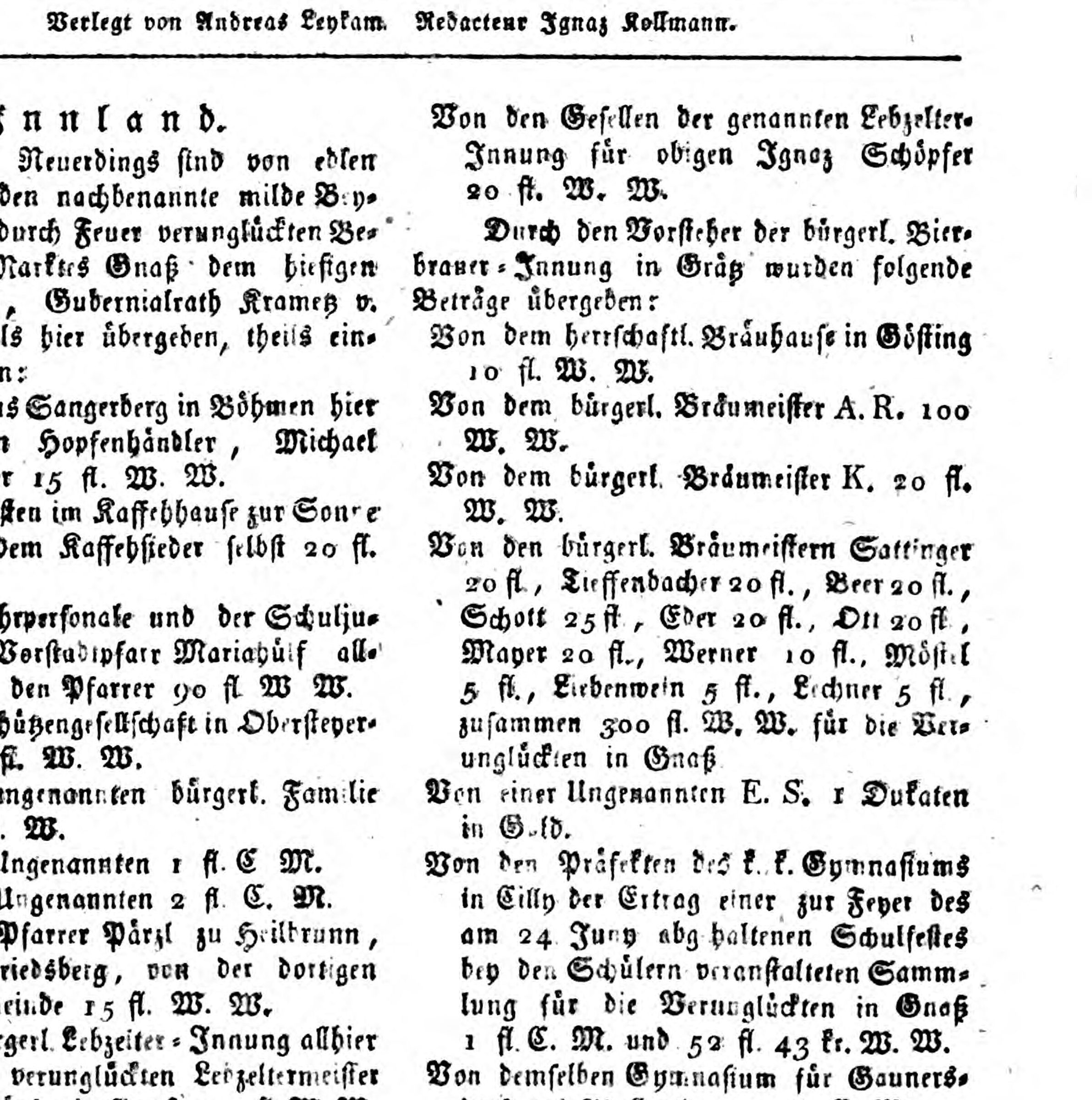
In July 1822 the burgher brewers’ guild collects for the victims of a fire at Gnas. The list names twelve Graz master brewers, with “Sattinger 20 fl.” at the head of it.
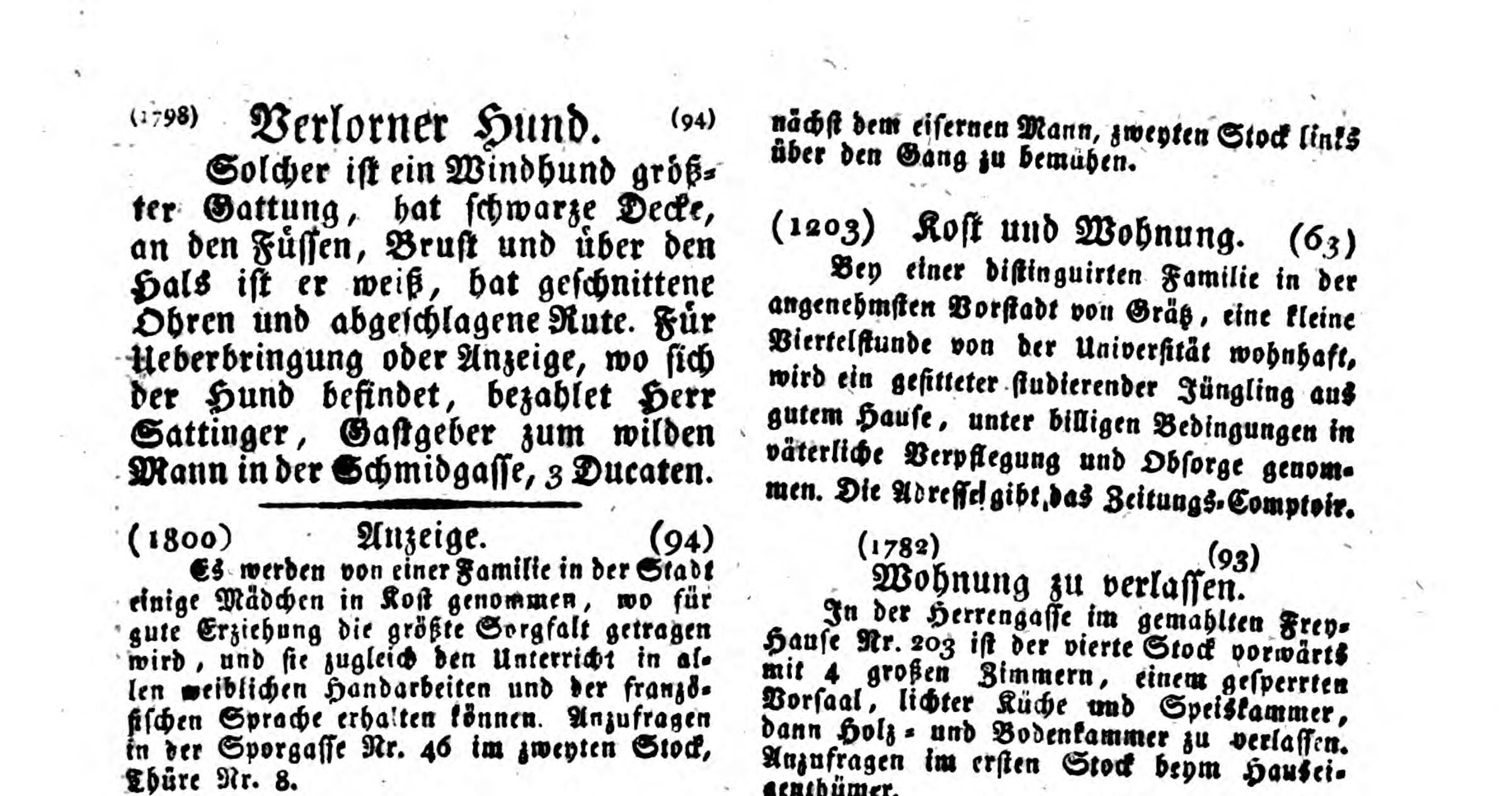
In November 1828 he is looking for a dog: “Verlorner Hund. Solcher ist ein Windhund größter Gattung, hat schwarze Decke …” — “Lost dog. A greyhound of the largest kind, black-coated, white on the feet, chest and over the neck, with cropped ears and a docked tail. For its return or for information … Herr Sattinger, innkeeper at the Wild Man in the Schmidgasse, pays 3 ducats.”
The name of the inn is thereby in a newspaper, and not only in memory.
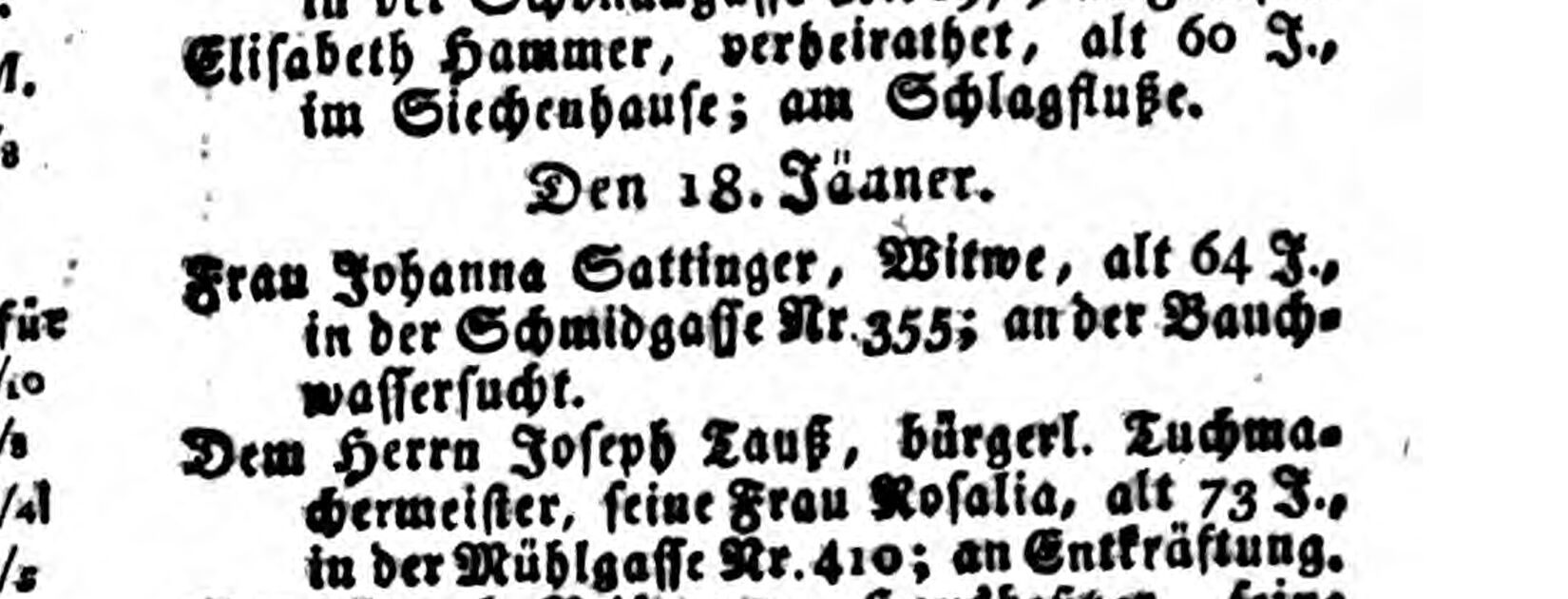
“Frau Johanna Sattinger, Witwe”
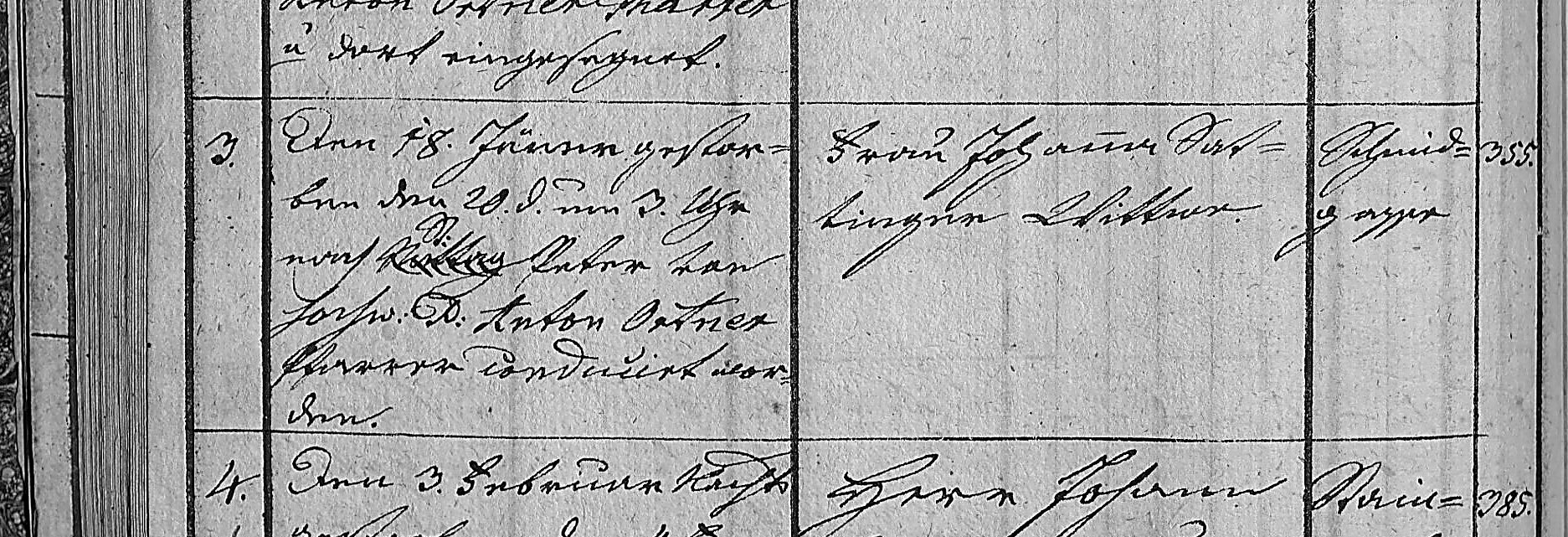
“Den 18. Jänner. Frau Johanna Sattinger, Witwe, alt 64 J., in der Schmidgasse Nr. 355; an der Bauchwassersucht.” — 18 January, Johanna Sattinger, widow, aged 64, in the Schmidgasse no. 355, of abdominal dropsy. The parish burial register says the same: “Frau Johanna Sattingerin Wittwe”, Schmidgasse 355, 64 years, buried on 20 January, blessed by parish priest Anton Ortner.
She dies in the master brewer’s house, at 64, so born about 1762: the age of a mother, not of a wife. Andreas was unmarried in 1821. No entry names the two together; the house and the age do°.
In 1804 a Johanna Sattingerin, widow, aged 40, had married the foreman Jacob Haik at the Calvary Hill. Whether it is the same woman remains open: in 1827 she dies under the name Sattinger.
“des Andreas Sattinger … als Vater”

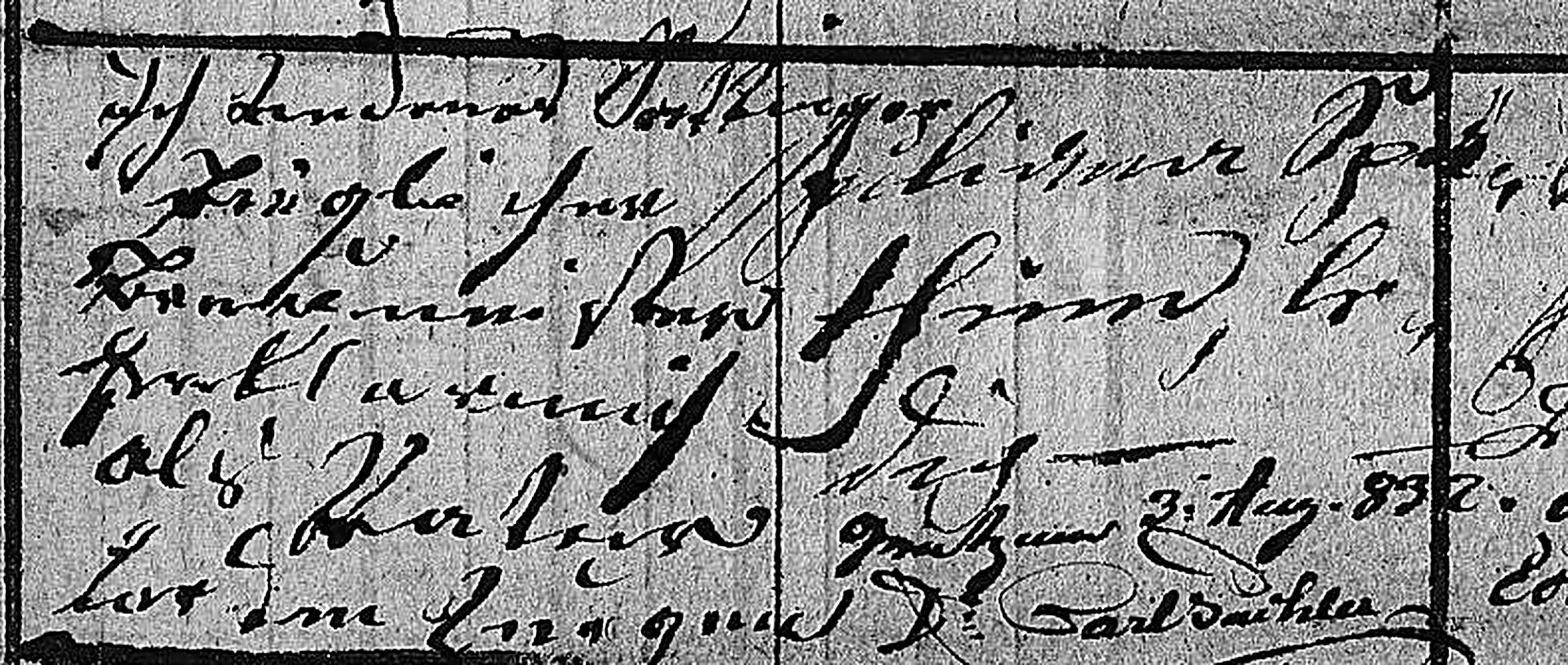
On 12 February 1824, at half past five in the morning, Josephus Andreas is born in the 2nd district, house 231, and baptised an hour later: illegitimate, mother Juliana Späth. The father’s column stays empty.
Eight years later another hand writes six lines into it, framed with heavy strokes: “des Andreas Sattinger … als Vater … Grätz am 3. Aug. 832” — naming Andreas Sattinger as the father, Graz, 3 August 1832. The baptismal index goes on listing the boy as Späth Josef.
Five and a half months after that, Andreas is dead.
December 1832, January 1833
On 20 December 1832 “Herr Andreas Sattinger”, at his own request, has his “Lager von guten Weinen im Hause Nr. 195 in der Schönaugasse” — his stock of good wines in house no. 195 in the Schönaugasse — sold at auction by the Teutonic Order’s commandery at the Leech.
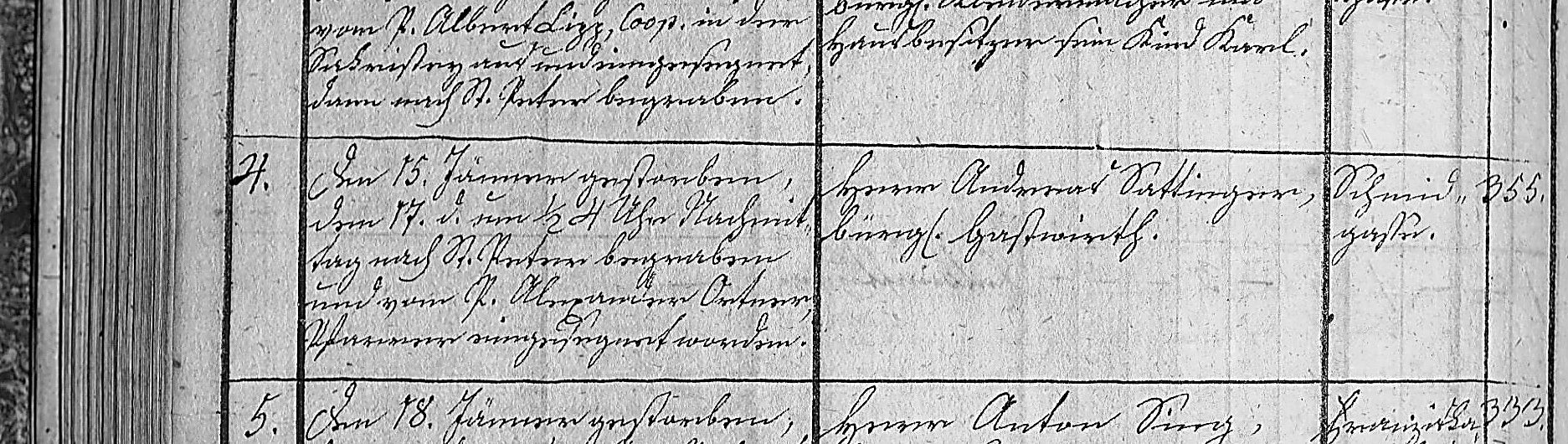
On 15 January 1833 he dies in the Schmidgasse 355: “Herrn Andreas Sattinger, bürgl. Gastwirth · 50 Jahre · Schleichendes Fieber · Mit Allem.” — burgher innkeeper, 50 years, slow fever, with all the sacraments. Buried on the 17th at half past three in the afternoon at St Peter, blessed by parish priest Alexander Ortner. The newspaper reports it two days later among the deaths in Graz.
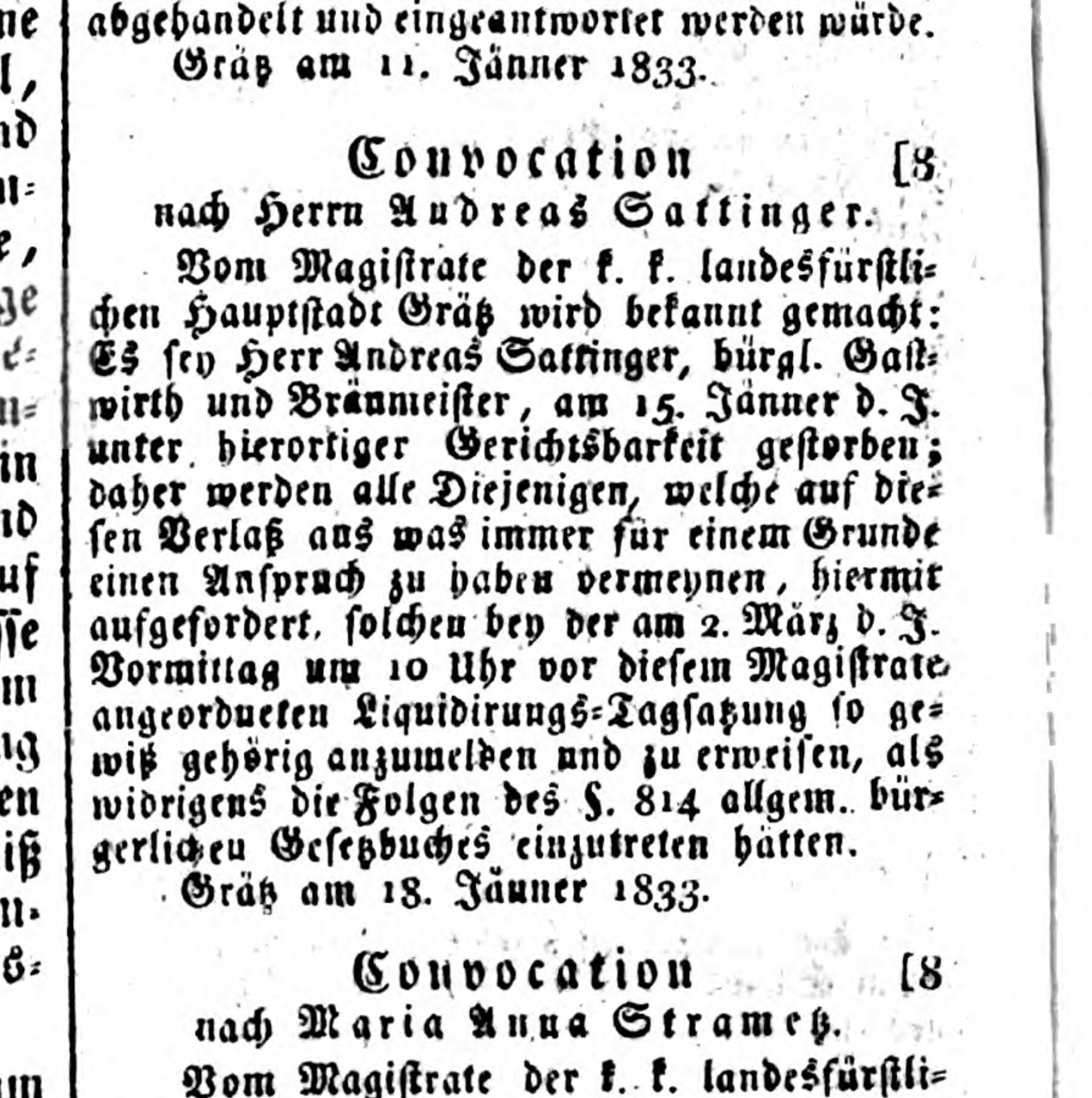
The magistrate’s convocation edict of 18 January says who settles the estate: “unter hierortiger Gerichtsbarkeit gestorben”, died under this court’s jurisdiction.
“250 bottles of champagne”
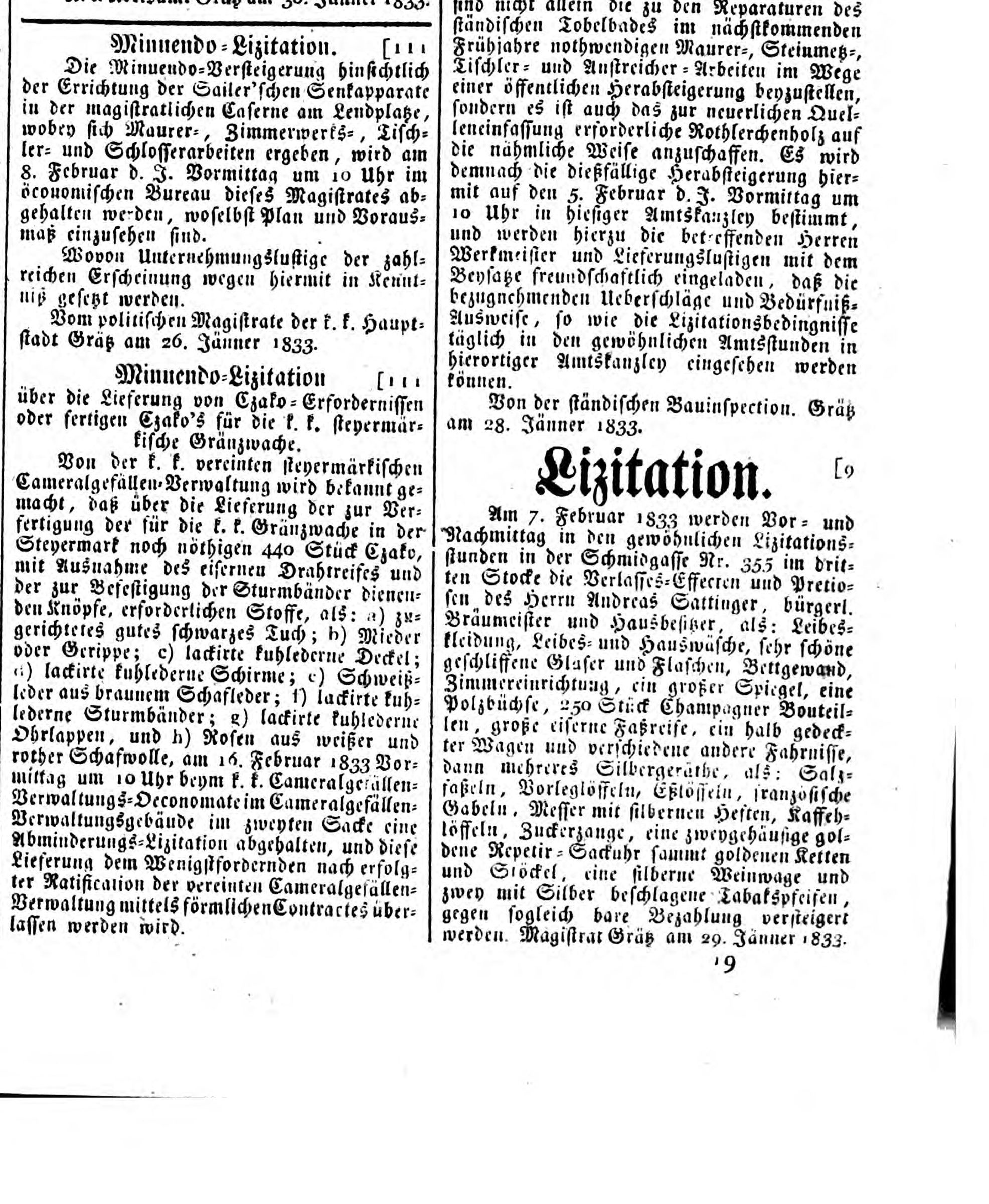
On 7 February 1833 the magistrate auctions, “in der Schmidgasse Nr. 355 im dritten Stocke”, on the third floor, the estate effects and valuables of Herr Andreas Sattinger, burgher master brewer and householder: “sehr schöne geschliffene Gläser und Flaschen … ein großer Spiegel, eine Polzbüchse, 250 Stück Champagner Bouteillen …” — very fine cut glasses and bottles, a large mirror, a bolt-gun, 250 bottles of champagne, large iron barrel hoops, a half-covered carriage, salt cellars, serving spoons, table spoons, French forks, knives with silver hafts, coffee spoons, sugar tongs, a double-cased gold repeating pocket watch with gold chains and fob, a silver wine balance and two silver-mounted tobacco pipes.
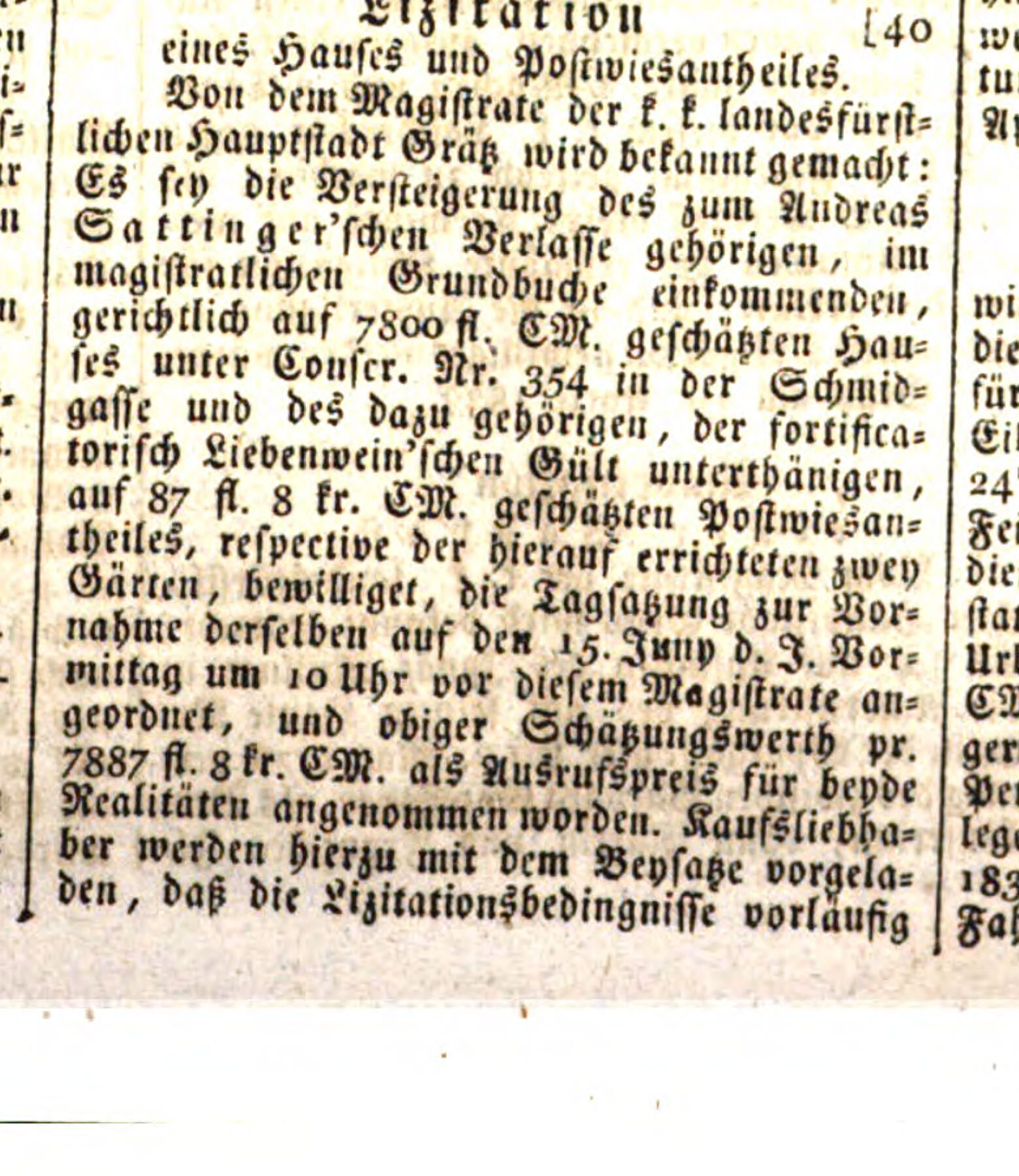
In May the house follows: “Conscr. Nr. 354 in der Schmidgasse”, valued by the court at 7,800 gulden, together with a share of the Postwiese meadow and two gardens.
Who inherited, none of the notices says. The son was nine.
“son of Andreas Sattinger, burgher master brewer … both already deceased”
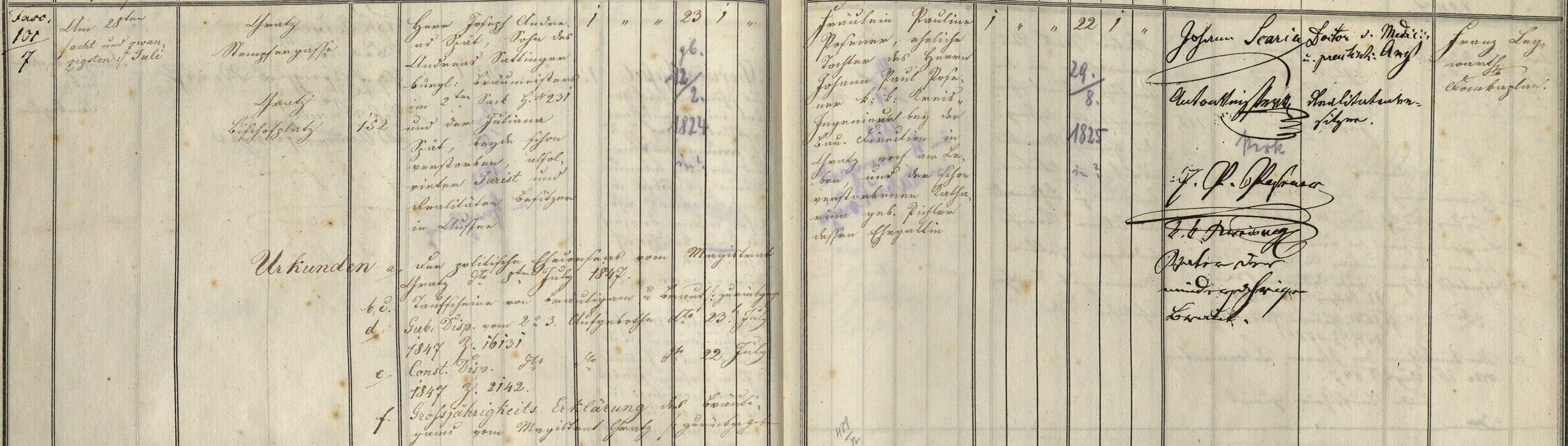
Herr Josef Andreas Spät, 23, “Sohn des Andreas Sattinger, bürgl: Bräumeisters im 2ten Bezirk H. N 231, und der Juliana Spät, beyde schon verstorben” — son of Andreas Sattinger, burgher master brewer in the 2nd district, house no. 231, and of Juliana Spät, both already deceased — a lawyer, marries Fräulein Pauline Poßener, 22, daughter of the Imperial-Royal district engineer Johann Paul Poßener and of the late Catharina née Pichler. Witness: Dr Johann Scaria, physician.
The groom is under age; the Graz magistrate issues him a declaration of majority, and the bride’s father signs as “Vater der minderjährigen Braut”, father of the under-age bride. A later pencil adds his date of birth: 12/2 1824. It is the date of the 1824 baptism, and the address is the same as there: house 231.
Five children on the Bischofplatz
The children’s baptismal entries write the father’s career alongside them. In 1848, at Ernst Josef, “Josef Späth Sattinger” is the owner of an estate called Grub. In 1851, at Konrad, he is an Imperial-Royal chancery official. In 1852, at Alfred, “k:k: Concepts Adjunct bey der k:k: Statthalterey”, drafting clerk at the governor’s office.
In 1855, at Josef, and in 1856, at Pauline Josefa Maria, it reads “Concepts Adjunct bei der k:k: Polizei-Direction in Pest”, at the police directorate in Pest. The father serves in Hungary; the family still lives at Bischofplatz 161. After April 1856 the cathedral baptises no further child of the couple.
The double name Späth-Sattinger stands in the register in 1848 and then no more; from 1851 the father is simply Sattinger.
“Josefus”

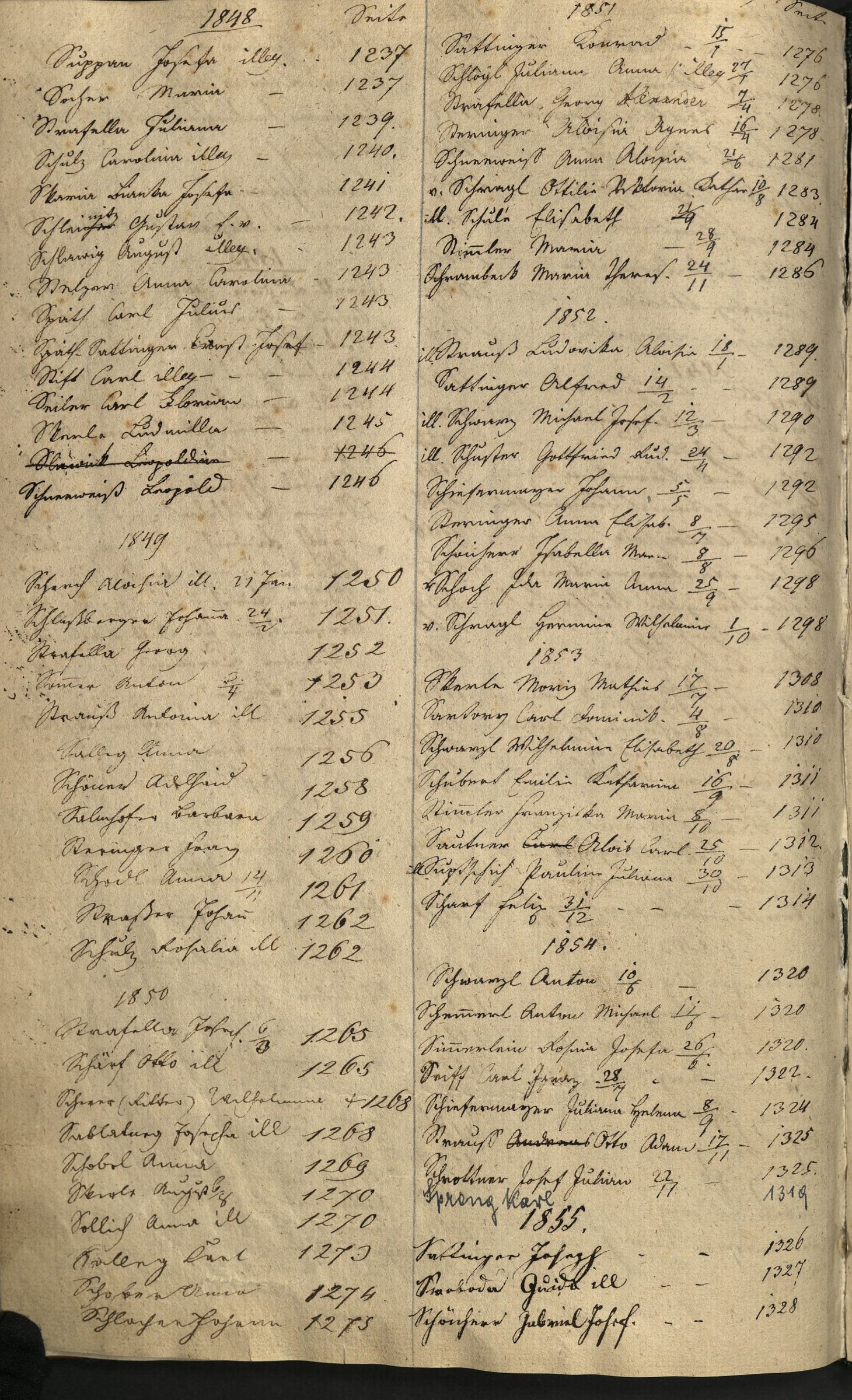
The first entry of the year 1855: born “Am 1ten = ersten Jänner 855 um 6 Uhr früh”, on the first of January at six in the morning, baptised on 2 January at half past two in the afternoon, Bischofplatz 161, legitimate, Catholic. Father Josef Sattinger, “k:k: Concepts Adjunct bei der k:k: Polizei-Direction in Pest”, mother Pauline geb: Poßener. Godmother Caroline Küstern, of independent means; the baptism by cathedral vicar Franz Casparuß; midwife Anna Gulla.
This is Valentin’s great-great-grandfather. The boy will go to school in Esztergom and have children in Arad.
“to the drafting clerk there, Joseph Späth-Sattinger”
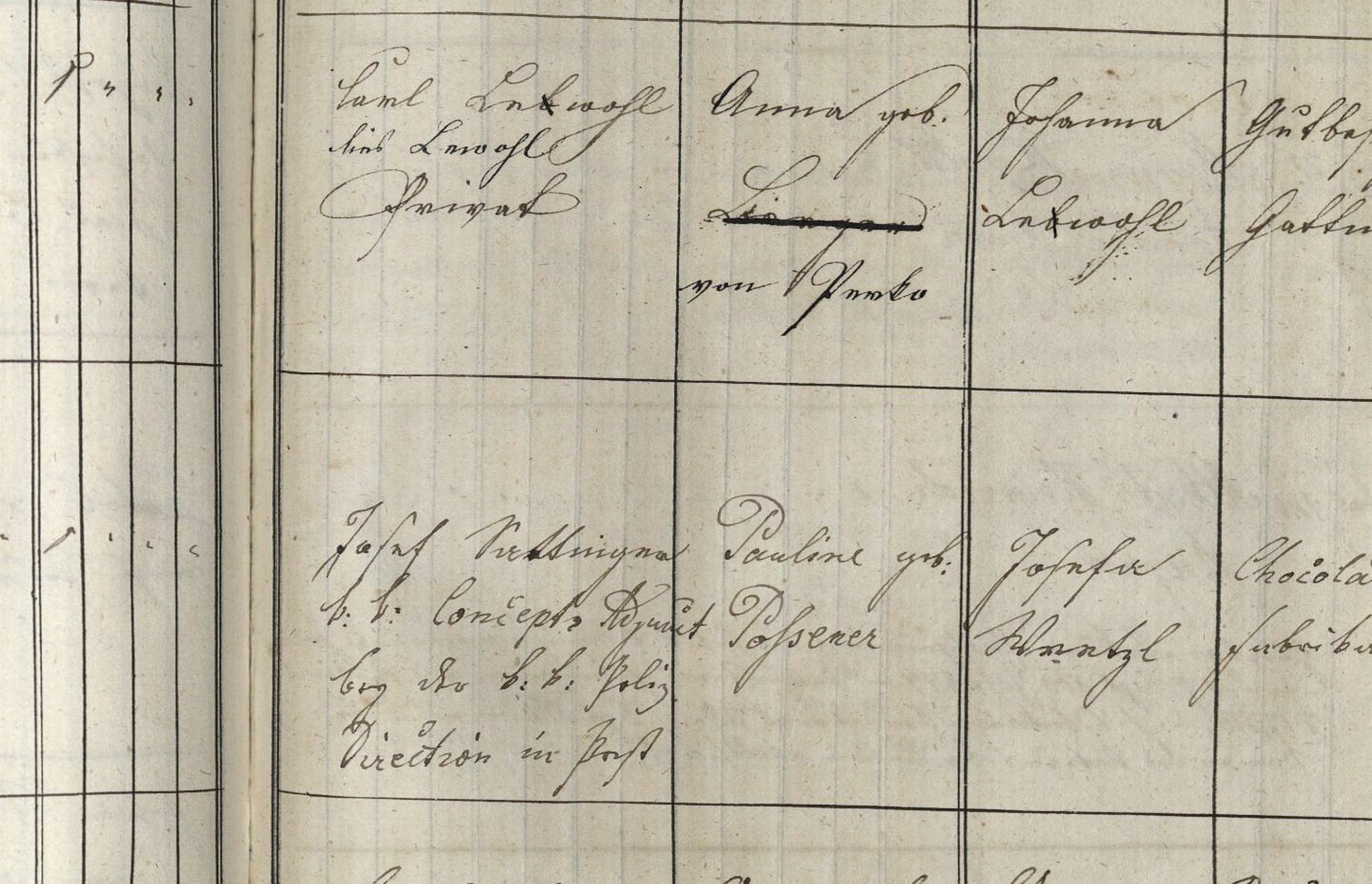
On 11 July 1856 the Wiener Zeitung announces in its official section: “Die Oberste Polizeibehörde hat eine bei der Polizeidirektion in Pesth-Ofen in Erledigung gekommene Kommissärsstelle dem dortigen Konzepts-Adjunkten, Joseph Späth-Sattinger zu verleihen befunden.” — the supreme police authority has seen fit to grant a vacant commissioner’s post at the Pest-Buda police directorate to the drafting clerk there, Joseph Späth-Sattinger.
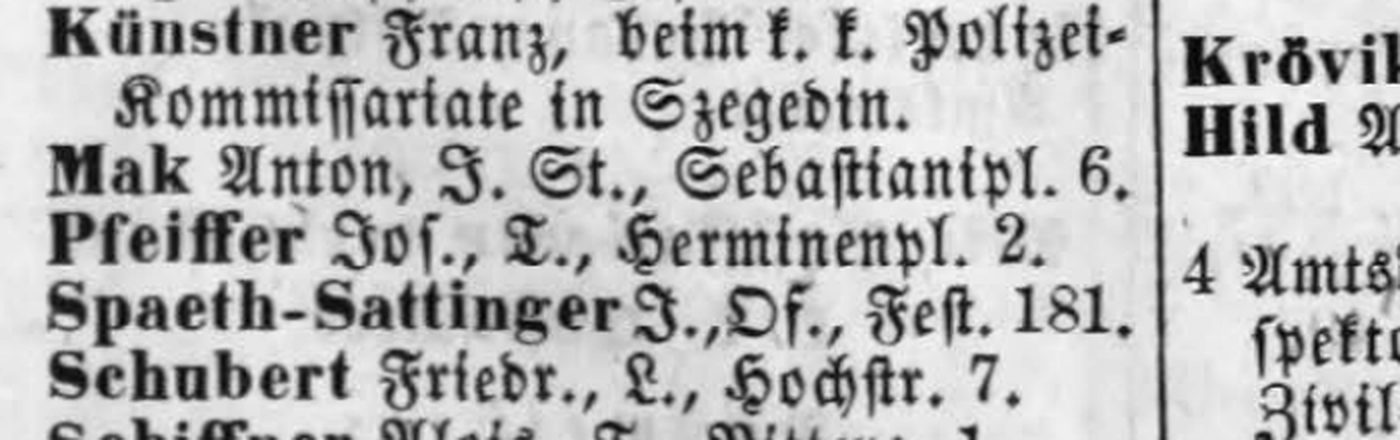
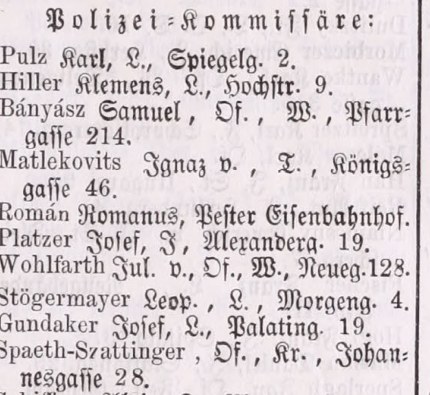
The Pester Lloyd almanac for 1859 lists him among the police commissioners: “Spaeth-Sattinger J., Of., Fest. 181.” — Buda, Fortress no. 181, in the castle quarter. In 1861 he gives to the Buda poor fund; the almanacs for 1866 and 1867 give the new address, “Kr., Johannesgasse 28.” From 1868 the name is in no Pest-Buda directory.
Esztergom
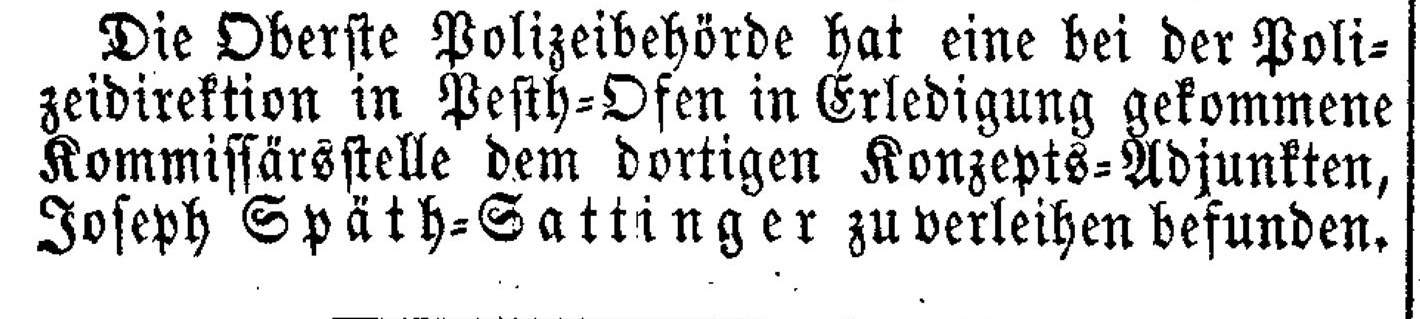
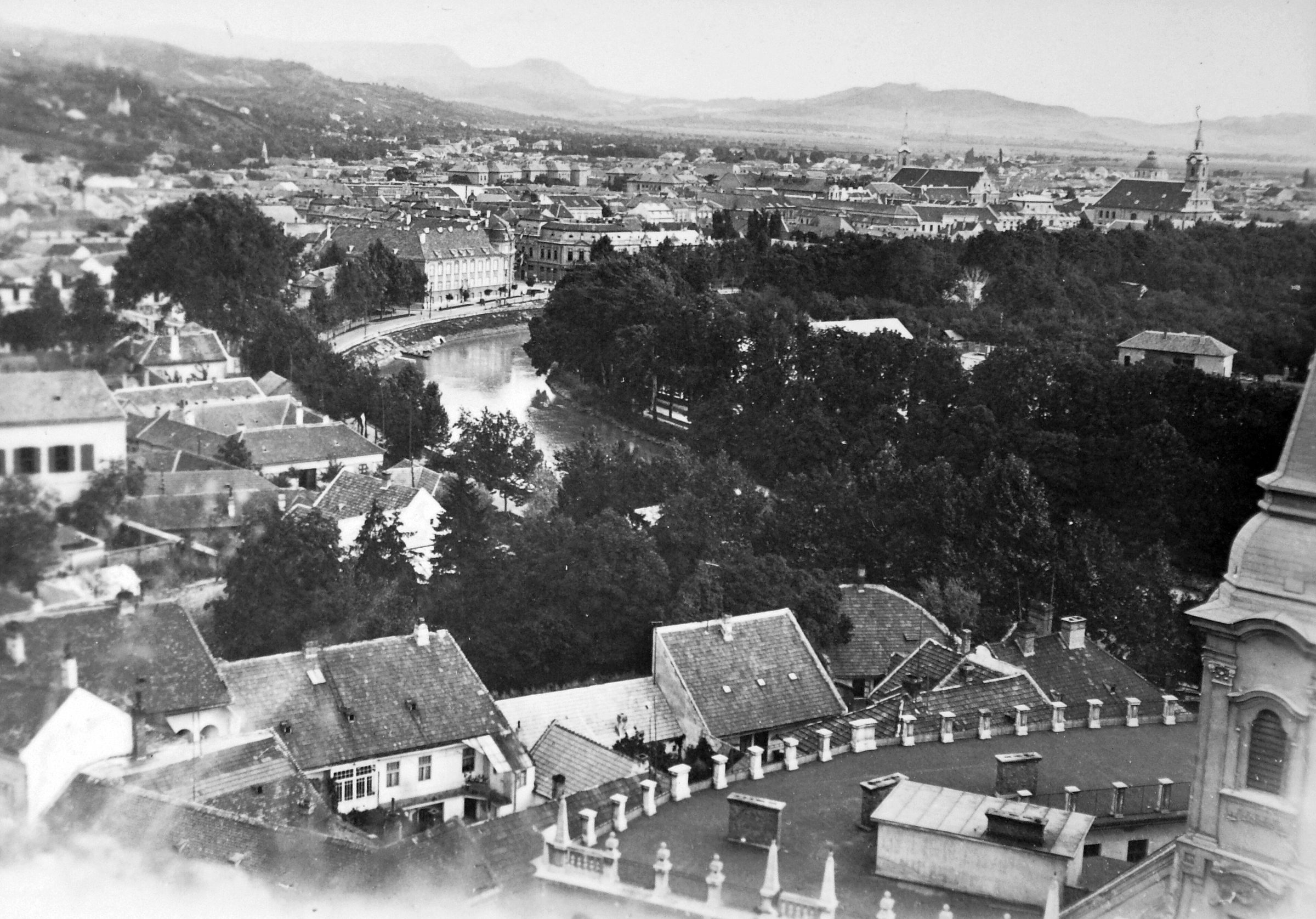
By 1868 at the latest the family is living in Esztergom: in that year the son Josef appears in the pupil list of the Benedictine gymnasium. Here Pauline dies on 15 December 1873, here Josef Andreas marries Josepha Námesnyi on 6 October 1874, and here he dies on 7 January 1892.
The three dates come from Reinhard’s tree, and all three are in the Esztergom parish registers. The address is documented too: the baptismal registers of the Szenttamás parish list the family at Szenttamás no. 260 from 1876 to 1879, and the town directory names “Szattinger József” in the Garádics-utcza 260 in 1891, and at the same number in 1894 “Szattinger Józsefné”, the widow°.
Three Esztergom entries
On 15 December 1873 Paulina Posener dies in the Water Town, house 31, “Sattinger Josephi musicae docentis uxor, e Marchburg Styriae” — wife of Josef Sattinger, teacher of music, from Marburg in Styria — aged 48, of consumption of the larynx. The vice-rector of the seminary buries her in Szentgyörgymező; the priest notes: “matrimonium duravit annis 26”, the marriage lasted 26 years.
Ten months later, on 6 October 1874, the widower, 52, marries the 34-year-old Josepha Námecsni, a master shoemaker’s daughter, in her house at Szenttamás 260. The entry names his parents, “Sattinger Andreae murarii mag. ac Späth Julianae filius”, and the priest who marries them: “Alfredus Sattinger, Cooper. Neo-Budensis, filius sponsi” — Alfred Sattinger, curate of Újbuda, the groom’s son, with the parish priest’s express permission.
On 7 January 1892 Szattinger József, zongora tanító, piano teacher, dies at 67 in the archiepiscopal hospital of a lung complaint. He therefore stands not in the register of his home parish but in that of the castle parish; he is buried on 9 January in Szentgyörgymező, like Pauline.



“musicae docens, oriundus Graecio”
In Esztergom the police commissioner is a music teacher. In the baptismal registers of the Szenttamás parish, Josef Andreas is called, in 1876, 1877 and 1879, “Sattinger Josephus, musicae docens, oriundus Graecio” — teacher of music, a native of Graz — resident at Szenttamás no. 260. His second wife Josepha Námesnyi comes from the same parish. Three children are baptised there: Francisca Henrica Paulina in 1876 and Vilhelmina Brigitta in 1877, both of whom die in their first year, and on 12 May 1879 Victor Henricus Joannes Nep., the teacher of 1896.
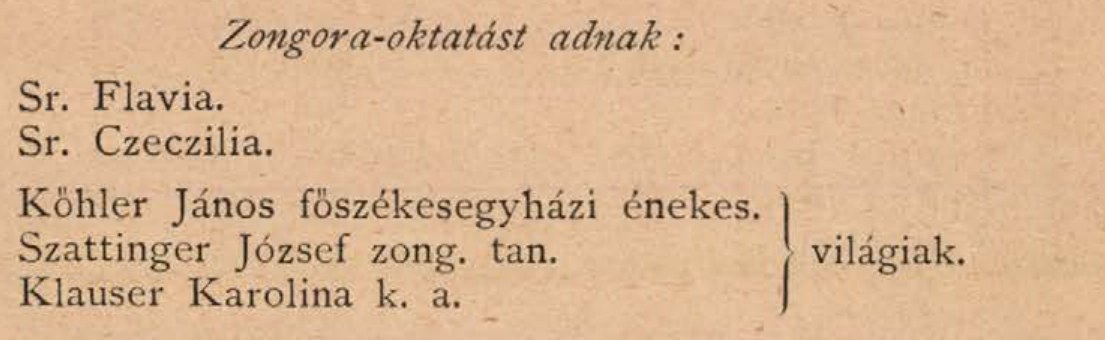
The annual report of the girls’ school in the Water Town lists among its piano teachers in 1883/84 “Szattinger József zong. tan.”, and in 1882, at his son’s marriage, he is called “zongoramester Esztergomban”, piano master in Esztergom. The piano teacher of family memory was not only Pauline. It was her husband too.
In 1884 the local paper names a “Sattinger Józsefné” in a list of ladies°: Josepha.

A priest and a lieutenant
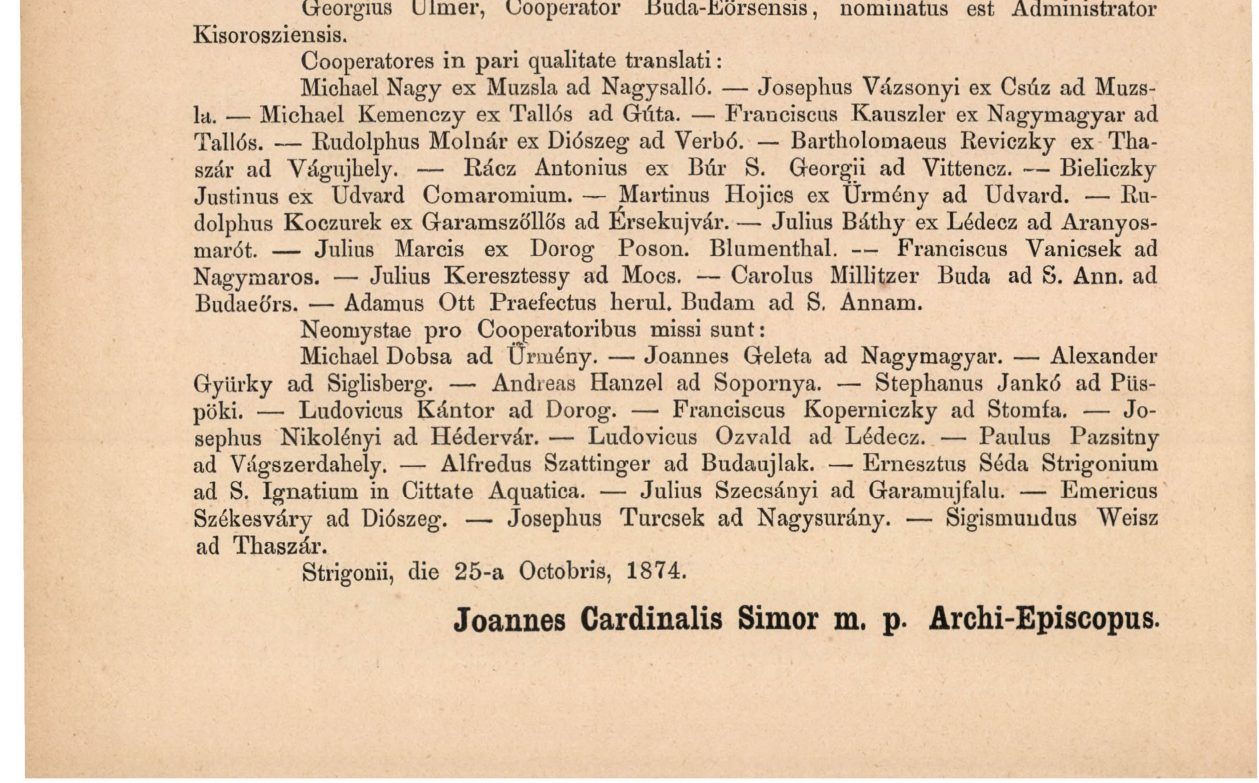
On 26 July 1874, the feast of St Anne, Cardinal Simor ordains seventeen new priests, among them “Sattinger Alfredus”. On 25 October he sends them to their first posts: “Neomystae pro Cooperatoribus missi sunt: … Alfredus Szattinger ad Budaujlak.” Alfred, baptised in Graz in 1852, is at 22 a priest and curate in Budaújlak, the new quarter of Buda.
Konrad, baptised in Graz in 1851, is in October 1872 a student at the agricultural college of Keszthely and secretary of its benevolent society. On 3 January 1881 the Pester Lloyd reports his transfer as a lieutenant “vom 26. Inf.-Reg. zum 70. H.-B.”, from the Esztergom home regiment to the Honvéd. The military schematisms list Alfred from 1877 to 1880 as a “Weltpriester der Erzdiöcese Gran (Res.)”, a secular priest of the archdiocese of Gran, in the reserve°.
The Hungarian books write the name Szattinger.

“Szattinger József”
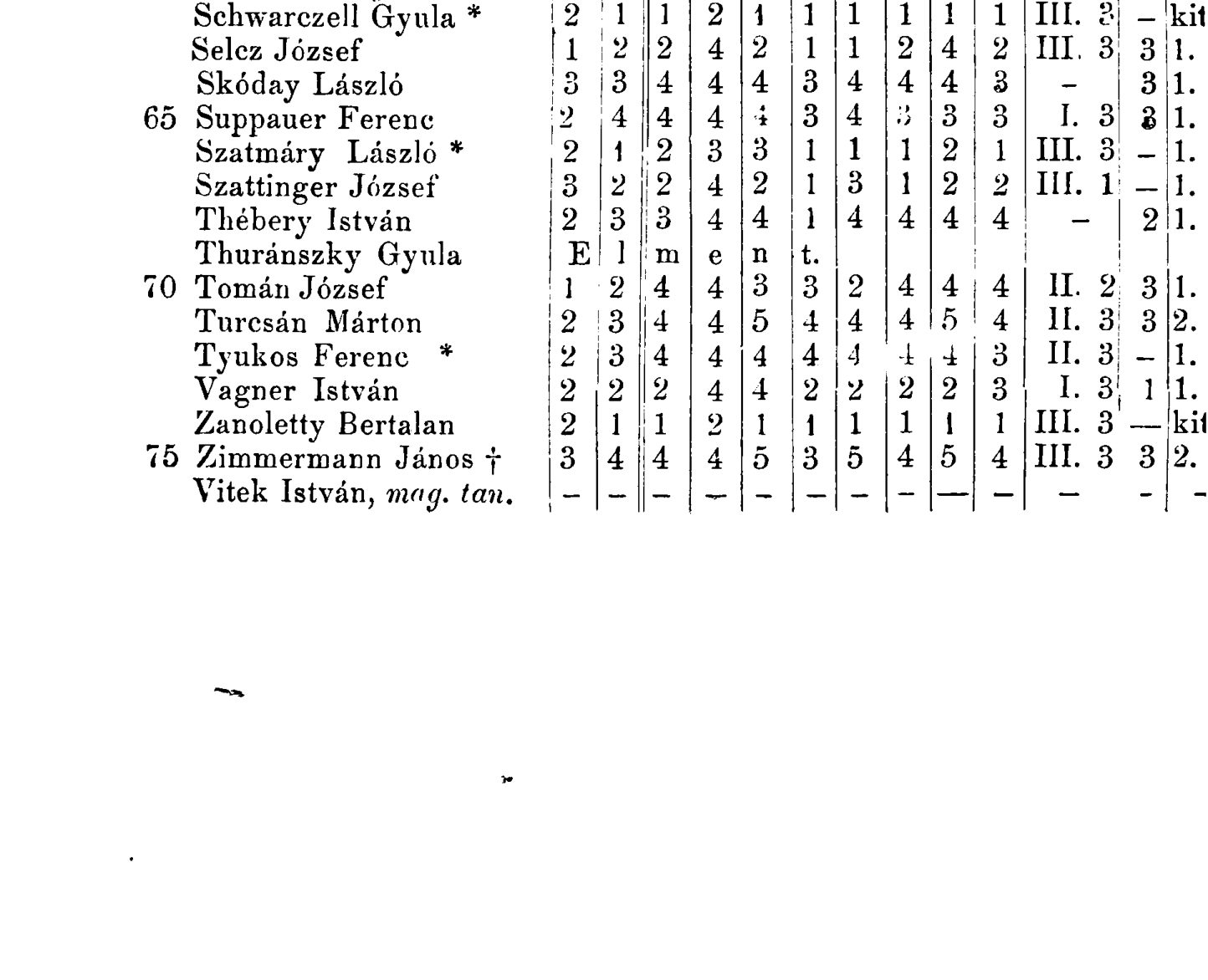
The marks table of the 1868 annual report lists him between Szatmáry László and Thébery István: “Szattinger József”, thirteen years old. German: 1, the top mark. Hungarian: 4. A boy raised in German in a Hungarian school.
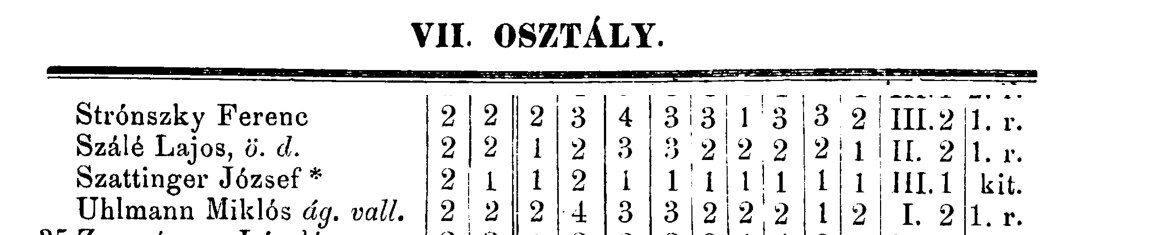
In 1872, in the seventh form, his line is almost nothing but ones, with the overall verdict “kit.”, kitűnő, excellent. In 1873, his final year, the eighth form lists him as “mag. tan.”, a private pupil, without a single mark.
In December of that same year his mother dies°. Whether he sat the school-leaving examination, the report does not say.

Dunabogdány, 4 June 1882
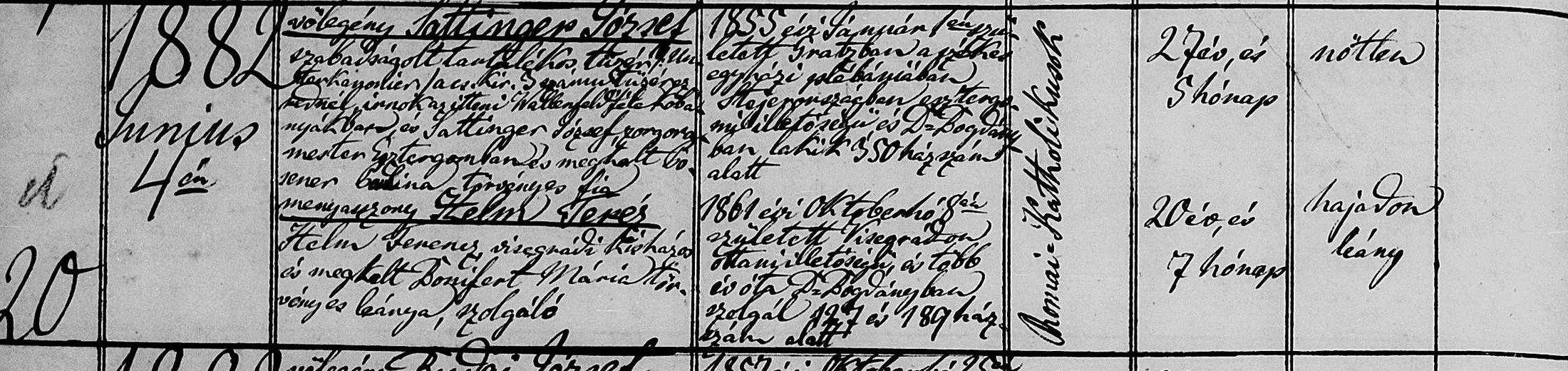
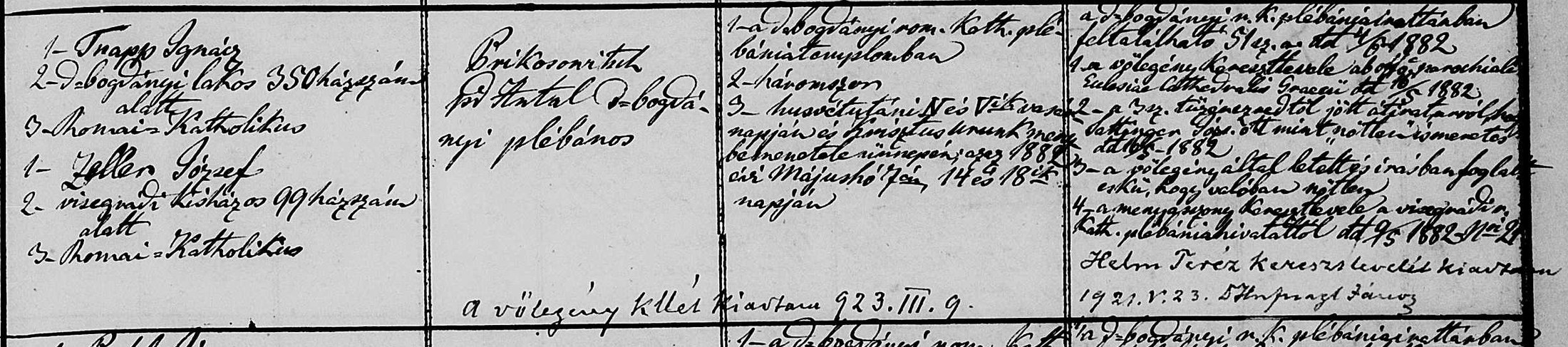
In the marriage register of the Danube-Swabian village of Dunabogdány, twenty-five kilometres downstream from Esztergom, the groom on 4 June 1882 is Sattinger József: “szabadságolt tartalékos tizedes a cs. kir. 5. számú tüzérezrednél, írnok az itteni Wallenfeld-féle kőbányában” — a reserve corporal on leave of the Imperial-Royal 5th artillery regiment, clerk in the local Wallenfeld quarry — son of “Sattinger József zongoramester Esztergomban”, piano master in Esztergom, and of the late Paulina Posener, born on 1 January 1855 in the cathedral parish of Graz. He is 27, unmarried, and lives in house 350.
The bride Helm Teréz, 20, is the daughter of the cottager Franz Helm of Visegrád and of the late Maria Bonifert, born on 8 October 1861 in Visegrád, and has been in service in Dunabogdány for years. The priest keeps on file the Graz baptismal certificate of 18 May, the regiment’s certificate of celibacy, and her baptismal certificate from Visegrád.
In 1921 and 1923 someone has copies drawn up. The same dates appear in the margin of the son’s marriage in Pécs.
Zebegény, Dunabogdány, Móriczföld
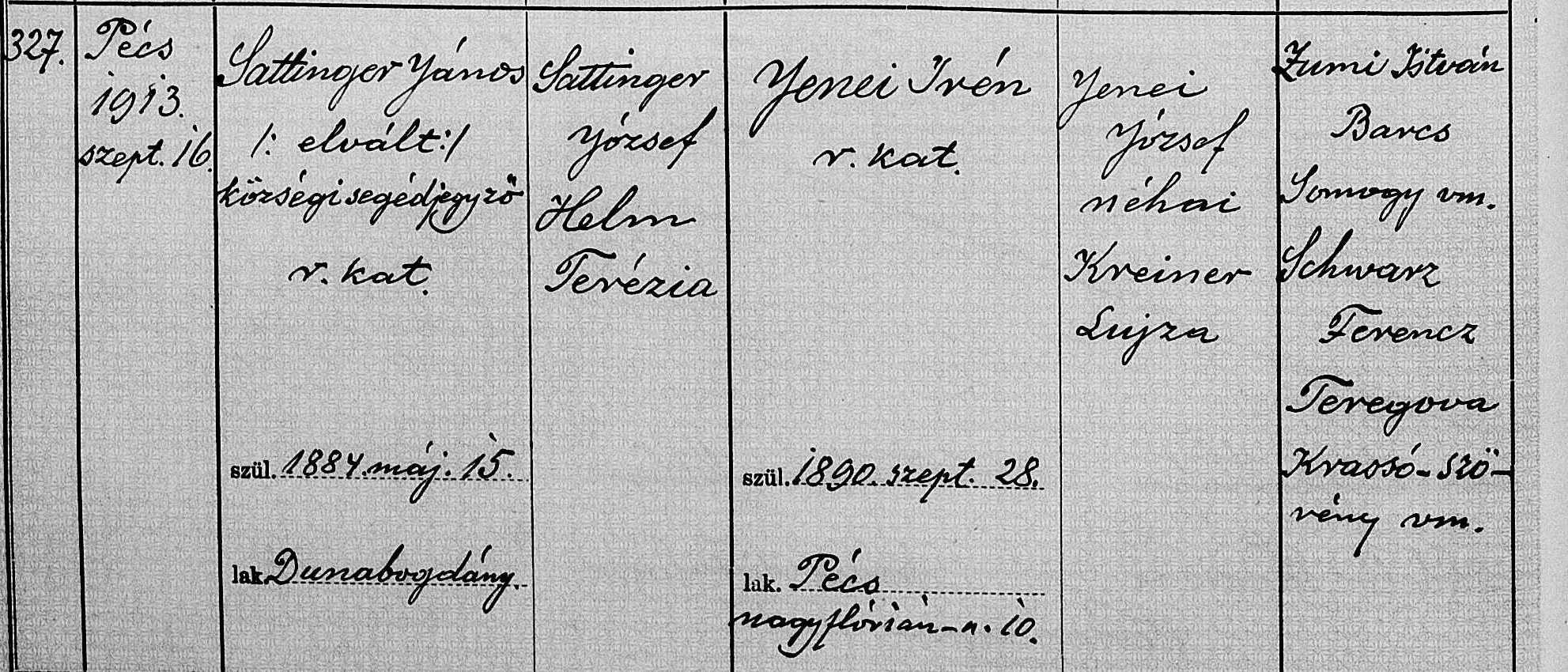
The first child is born on 5 March 1883 in Zebegény, on the other bank: Franciscus Xaverius, parents “Szatinger Josef, Helm Theres”. In the margin stands “† 1883 2/5”, eight weeks. On 15 May 1884 Nepomuki János follows in Dunabogdány, house 102; the father is still “írnok a Wallenfeld-féle kőbányában”, clerk in the Wallenfeld quarry. The godmother is a née Bonifert.
János becomes a village notary. On 16 September 1913 he marries in Pécs, divorced, “községi segédjegyző”, assistant village notary in Móriczföld in Temes county, one Irén Jenei; parents “Sattinger József, Helm Terézia”, both living. In 1924 he marries a second time, in Szigetvár. Between 1884 and 1886 the family moves to Arad.
The Banat of family memory does not begin with the Helms. It begins with this move.


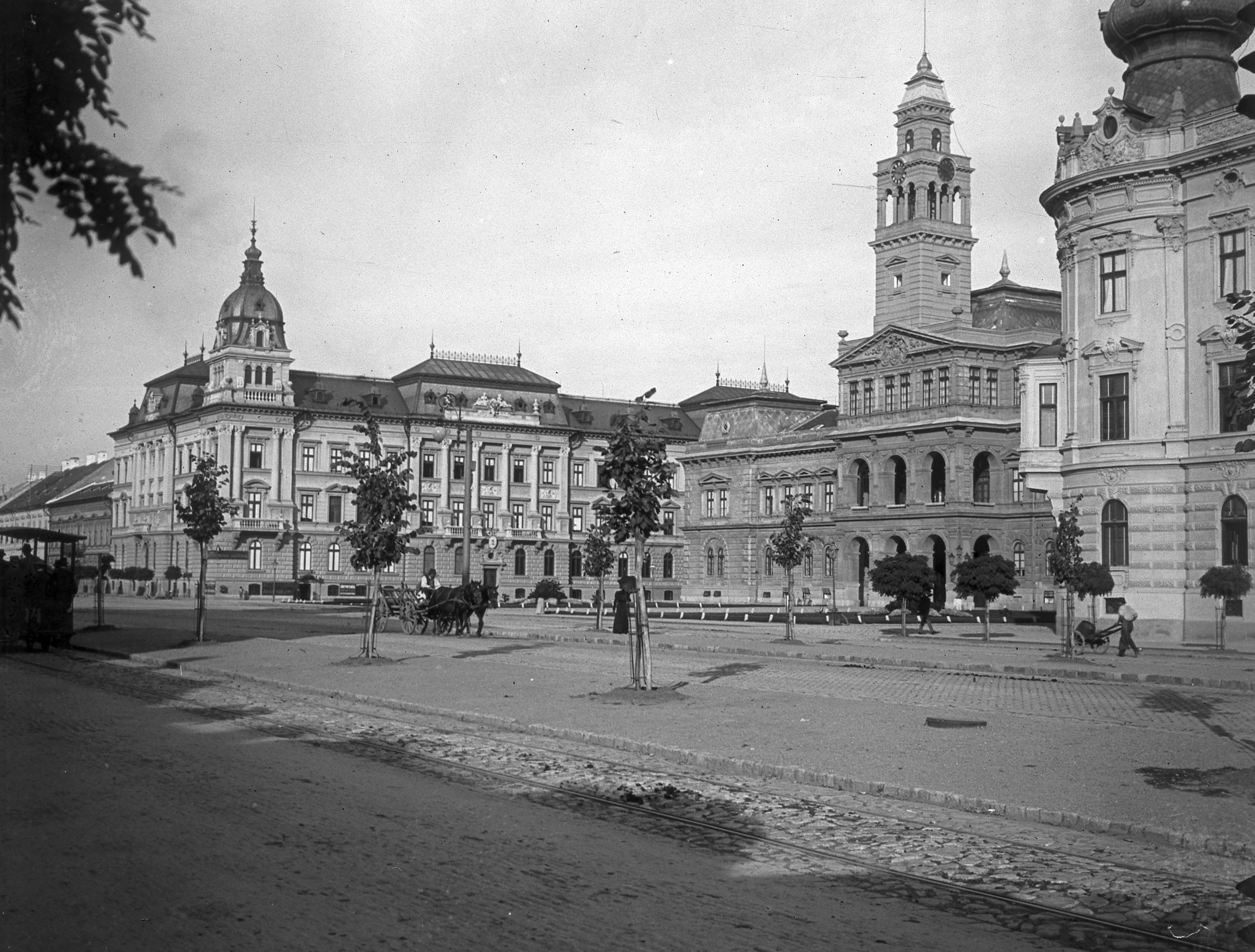
Arad, 30 October 1886
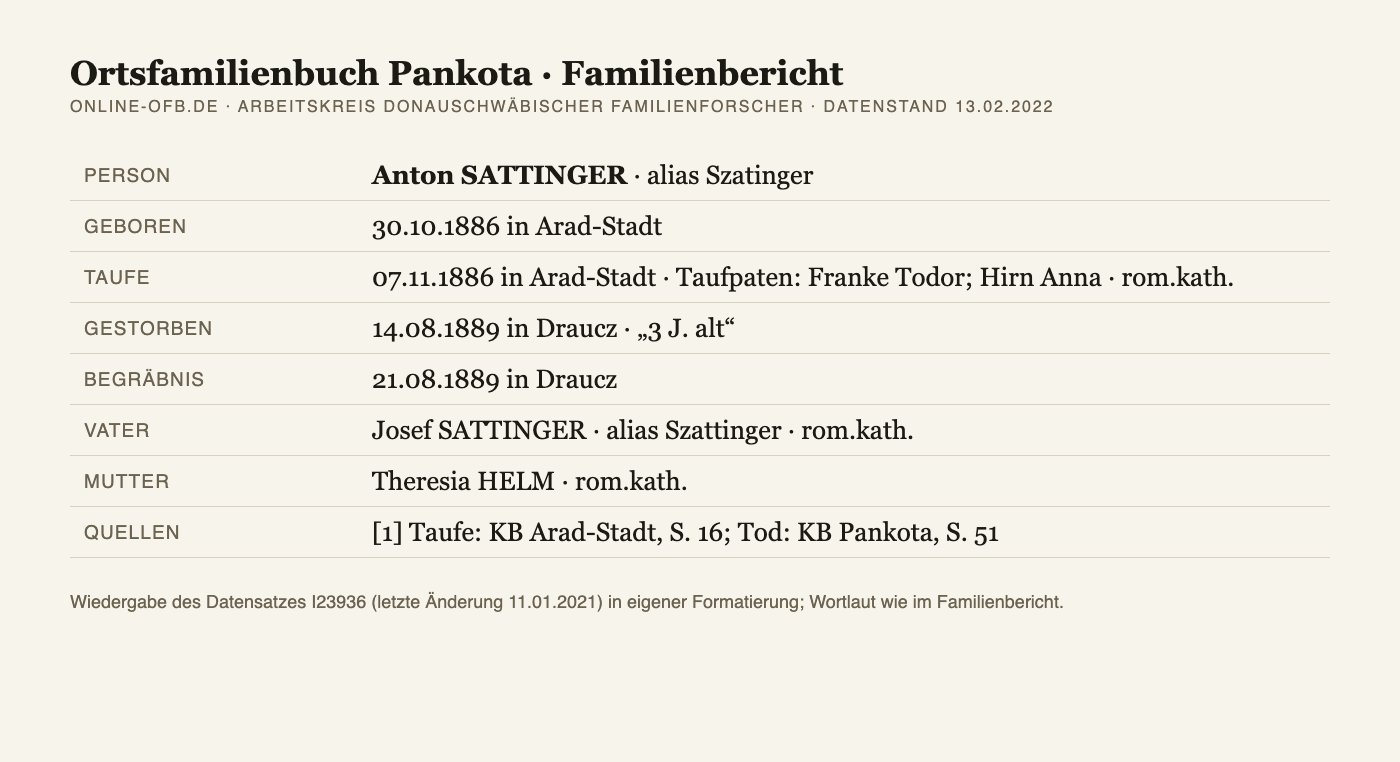
On that day Anton Sattinger is born in Arad and baptised on 7 November, godparents Franke Todor and Hirn Anna, father Josef Sattinger, mother Theresia Helm. On 14 August 1889 the boy dies in Draucz, thirty kilometres to the east, and is buried there on 21 August: “alias Szatinger; 3 J. alt”, aged three.
The local family book of Pankota has copied both entries out of the parish registers. They are the family’s first place in Arad county, and Anton is a child the family knew nothing about.
Josef Sattinger and Theresia Helm have been married since 4 June 1882. The couple of the Dunabogdány marriage register and the couple of the Arad parish register are the same people.
Therese Helm, and a son of 1903
Theresia Helm is born in Visegrád on 8 October 1861 and baptised on the 10th: “Helm Franciscus, colonus; Bonifert Maria; RC; Visegrád N° 151.” The family tree has the date to the day, and it has the parents: Franz Helm, 1834°, and Maria Anna Bonifert, 1838°, whose own parents were Johann Helm and Katharin Gerstenmaier, Franz Bonifert and Katalin Ott°. The names are those of the Swabian villages of the Danube Bend, Visegrád and Dunabogdány, not those of the Banat.

On 14 August 1903 Josef Emanuel is born°, seventeen years after Anton and nineteen after János. Where, the tree does not say, and no register in this presentation does either. Josef is 48, Theresia 41; between 1886 and 1903 further children are to be expected.
In 1913 Josef and Therese are still alive. When they died is not known.
The registrar of Prigor
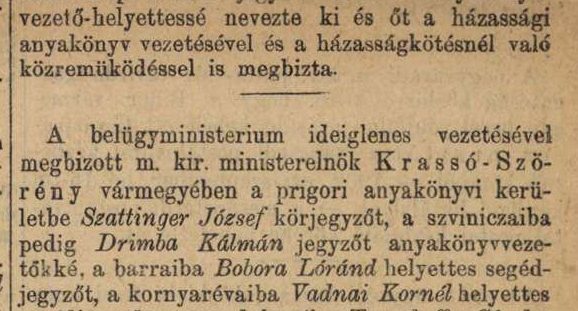
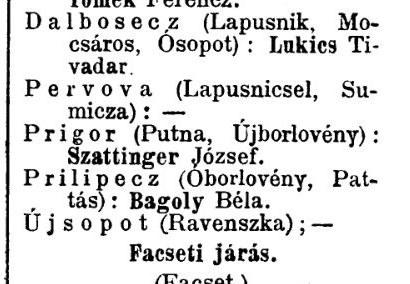
In September 1897 the official gazette makes the notary’s clerk Szattinger József deputy civil registrar of the Bokszeg district in Arad county, with charge of the marriage register. In October 1898 the interior minister moves him to Zsgribest in Krassó-Szörény county, in December 1900 to Zsupanek near Orsova, and on 6 September 1902 he becomes “körjegyző”, district notary and civil registrar of Prigor in the Almás valley. The official directory lists him there in 1906 and 1907: “Prigor (Putna, Újborlovény): Szattinger József.”
Where Josef Emanuel was born on 14 August 1903, no register in this presentation says. On that day his father had been the registrar of Prigor for eleven months°. Theodora, the daughter, scores a 1 in every subject in the fourth form of the Orsova town school in 1904.
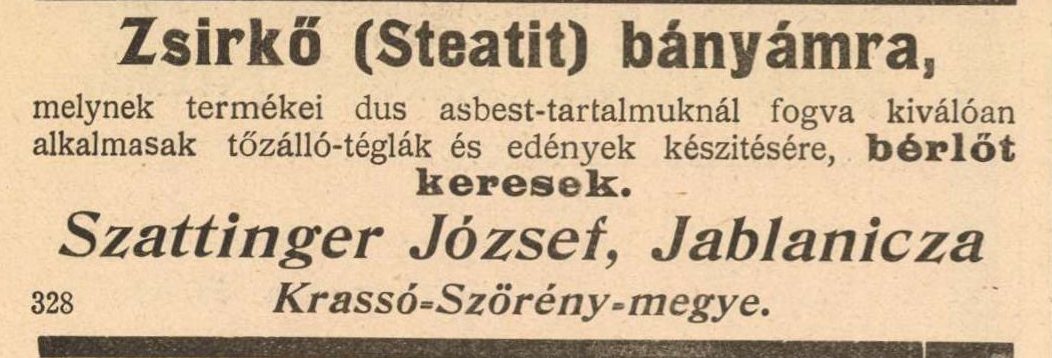
In June 1907 he is looking for a tenant for his soapstone mine: “Zsirkő (Steatit) bányámra … bérlőt keresek. Szattinger József, Jablanicza.” In the 1908 official directory he no longer appears. In March 1911 he is looking, now from Temesmiklós, for a contractor for the mine.
János, the son, advertises from Prigor in 1907 for a post as a clerk, “fluent in German and Romanian”. By 1917 he is district notary of Szigetfalu in Temes county.
“Translated into German by Josef Sattinger. Arad. 1888”
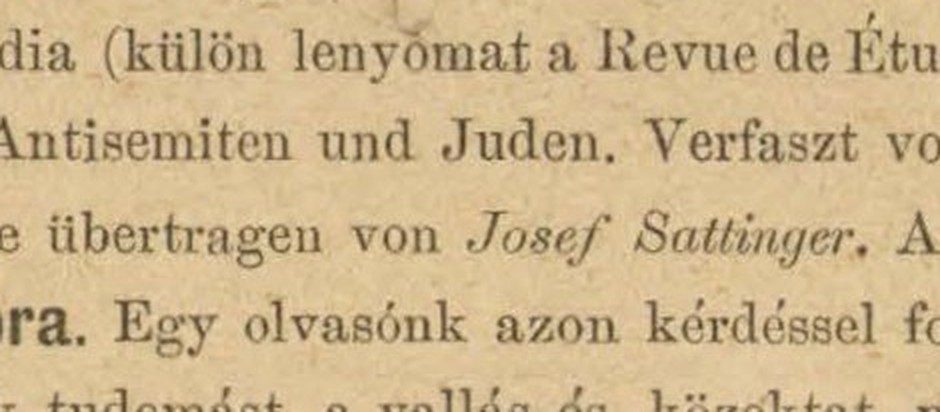
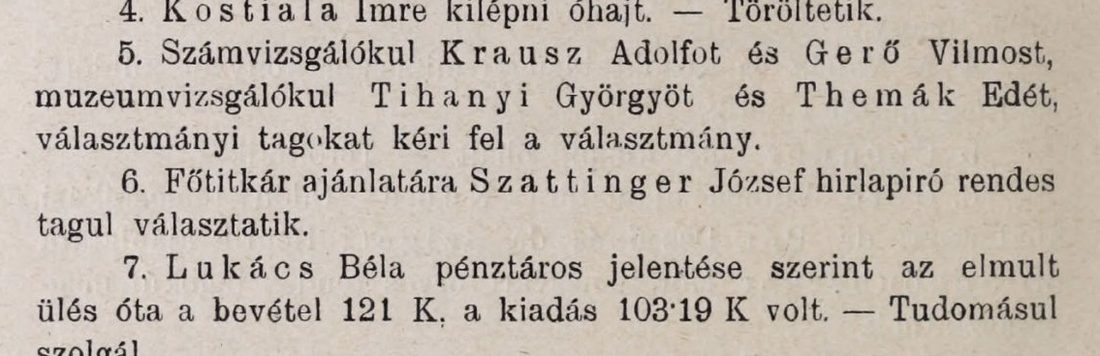
In 1888 a Budapest journal notices a pamphlet, “Allerlei über Antisemiten und Juden” — sundry matters concerning antisemites and Jews — translated from the Hungarian by Josef Sattinger in Arad. The boy who in 1868 in Esztergom had a 1 in German and a 4 in Hungarian is, at 33, translating between the two languages.
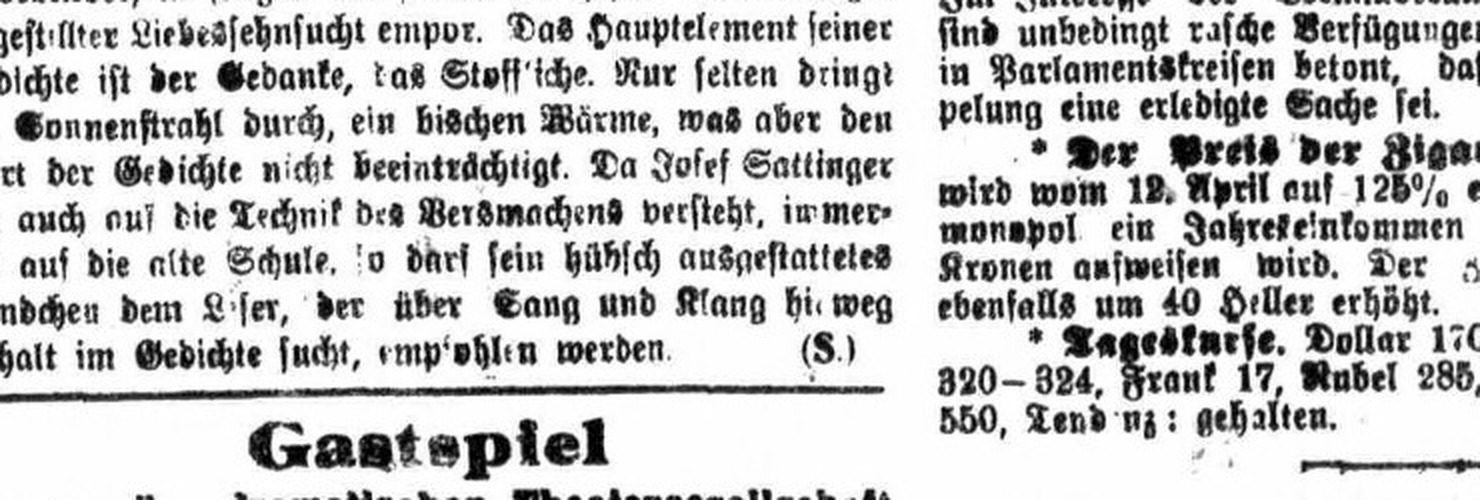
On 21 December 1911 the natural science society of Temesvár admits “Szattinger József hírlapíró”, journalist, as a member°. On 7 April 1920 the Temesvarer Zeitung reviews a volume of his poems: “Da Josef Sattinger sich auch auf die Technik des Versmachens versteht, immerhin auf die alte Schule, so darf sein hübsch ausgestattetes Bändchen dem Leser … empfohlen werden.” — since Josef Sattinger also understands the craft of versifying, of the old school at any rate, his handsomely produced little volume may be recommended to the reader. Until 1931 papers in Arad and Temesvár advertise his poems, his “Swabian Homeland” and a local history of the Banat°.
On 11 January 1923 a “Uebersetzer aus dem Ungarischen in’s Deutsche”, a translator from Hungarian into German, seeks permanent employment. Address: Sattinger, Elisabethstadt, Rabengasse 36. Josef is 67.